

For many companies entering the UAE, the first question is:
Mainland or Free Zone?
For an international business, that question often comes too early.
Before choosing where to incorporate, a company should first understand what the UAE entity will do, who its customers are, how it will operate, who should own it, what approvals it needs and how the business may evolve over the next few years.
The legal structure should follow the commercial strategy – not the other way around.
That matters increasingly as the UAE attracts more sophisticated international investment. The country received US$48.3 billion in FDI in 2025, ranking ninth globally, while Dubai recorded 1,253 greenfield FDI projects and retained the world’s No.1 position for headquarters-related greenfield projects.
For companies considering Dubai, incorporation is therefore only one part of market entry.
What should a company decide before setting up in Dubai?
Before incorporating, a business should define its commercial purpose, customers, activities, jurisdiction, legal structure, ownership, banking requirements, premises, workforce, regulatory approvals, future expansion and overall market-entry budget.
These decisions are closely connected. A structure that looks simple at the beginning can become inefficient as the company hires, raises capital, enters regulated sectors or expands across the GCC.
Here are the 12 decisions worth making before incorporation begins.
1. What is the commercial purpose of the UAE entity?
Start with a basic question:
Why does the company need to exist?
A UAE company created primarily to provide consultancy services internationally may require a very different structure from an organisation establishing a regional headquarters with 30 employees.
Likewise, a trading company importing goods into the UAE has different requirements from an intellectual-property holding company, healthcare facility or manufacturing operation.
Before discussing jurisdictions, define whether the proposed entity will operate as a:
- UAE operating company
- regional sales office
- Middle East headquarters
- trading company
- professional-services business
- technology or SaaS company
- holding company
- investment vehicle
- manufacturing operation
- logistics business
- retail or hospitality business
- regulated healthcare or educational establishment
Consider two companies both described as “technology businesses”.
The first develops software in Dubai and sells subscriptions globally with five employees.
The second contracts with UAE government and enterprise clients, employs 40 people, stores customer data locally and plans to expand into Saudi Arabia.
Their licence descriptions may sound similar.
Their optimal market-entry structures may not be.
The first decision in UAE market entry is therefore not the licence. It is the role the UAE company will play within the wider business.
2. Who will your customers be?
The location and type of your customers should influence the structure.
Key questions to consider include::
- Will revenue mainly come from overseas customers?
- Will the company contract directly with UAE businesses?
- Will customers include government entities?
- Will products be imported and distributed locally?
- Will the business operate through distributors?
- Is the model B2B, B2C or both?
- Does the company need a physical customer-facing location?
Historically, discussions about local UAE business often quickly became a Mainland-versus-Free-Zone decision.
That distinction is evolving.
Dubai’s Executive Council Resolution No. 11 of 2025 established mechanisms through which eligible Dubai Free Zone establishments may conduct approved activities outside their Free Zone through a branch within Dubai, a branch operating from the Free Zone, or a temporary activity permit, subject to applicable conditions and approvals. The framework also requires separate financial records for activities carried out outside the Free Zone.
This means the market-entry question is becoming more nuanced than:
“Do you need Mainland customers? Then choose Mainland.”
A better question is:
How will the company contract, deliver, invoice and operate in the UAE, and what structure supports that model efficiently?
3.What activities will the company actually perform?
Business activity selection is not simply administrative wording on a trade licence.
It determines what the company is legally authorised to do and may determine which regulator, authority, premises or professional approvals are required.
Consider the differences between:
management consultancy and investment advisory;
software development and regulated financial technology;
general trading and specialised product distribution;
wellness services and healthcare treatment;
marketing services and recruitment;
property consultancy and regulated real-estate brokerage.
The commercial description used by a founder does not always correspond directly with the licensing classification used by the relevant authority.
This is why the activity should be mapped against the actual revenue model.
Assess:
- What services will customers pay the company for?
- What will appear on contracts and invoices?
- Will products be imported, distributed or manufactured?
- Does another regulator need to approve the activity?
- Are professional qualifications required?
- Does the activity impose premises requirements?
A company should not select an activity merely because it is quicker or cheaper to obtain if that activity does not properly reflect the business being conducted.
The UAE government’s current Mainland guidance similarly notes that certain activities require approvals from other government entities in addition to the normal establishment process.
4.Mainland, Free Zone or a specialist jurisdiction?
Only after understanding the business model, customers and activities should jurisdiction selection begin.
Dubai Mainland
A Mainland entity may make sense where the company expects substantial UAE operations, requires a physical retail or commercial presence outside a Free Zone, needs particular regulated activities or wants a structure aligned closely with domestic operations.
Foreign investors can now own 100% of many Mainland companies, although activities considered to have strategic impact can remain subject to specific requirements.
General-purpose Free Zones
A Free Zone may be highly effective for businesses focused on international services, trading, startups, regional operations or businesses that benefit from streamlined administration and flexible workspace solutions.
But “Free Zone” is not one single proposition.
Different zones vary considerably in:
licensing activities, office requirements, visas, industry focus, reputation, infrastructure, operating rules and cost.
Specialist jurisdictions
A business may also have strategic reasons to consider environments such as DMCC, DIFC, ADGM, JAFZA, Dubai South, DAFZA or Dubai Healthcare City depending on the activity.
The goal is therefore not to determine which jurisdiction is “best”.
A better way to assess jurisdiction is to look at how well it fits the company’s overall operating model. This includes the nature of its commercial activities, customer base, regulatory requirements, premises, workforce, banking needs, ownership structure and longer-term expansion plans.
5. Should you establish a branch, subsidiary or standalone company?
This question becomes particularly important when an existing international company enters the UAE.
There are several possible approaches.
| Structure | Typical characteristic | Strategic consideration |
|---|---|---|
| Foreign company branch | Extension of the foreign parent entity | Useful where the parent wants to operate directly through its existing corporate identity |
| UAE subsidiary | Separate UAE company owned by the foreign parent | Can provide clearer separation between parent and local operations |
| Founder-owned UAE company | Shares held directly by individuals | Can be simple initially but should be considered against future group structure |
| Joint venture | Ownership shared with another party | Requires careful governance, control and exit provisions |
| Holding company + operating company | Ownership separated from operations | Can support wider group structuring, multiple businesses or investment planning |
The UAE Ministry of Economy and Tourism maintains a separate registration framework for branches of foreign companies, including initial approval and supporting corporate documentation from the overseas parent. The activities licensed to the UAE branch should generally correspond with the activities carried on by the parent company, subject to the requirements and approvals of the relevant UAE authorities.
A branch is also not a separate shareholder-owned company. It is an extension of the foreign parent, meaning additional shareholders or investors cannot simply be introduced at branch level. If the group intends to bring in new investors or partners in the UAE operation, a separately incorporated subsidiary or another corporate structure may therefore be more appropriate.
For many multinational groups, a subsidiary can provide clearer separation between the UAE operation and the foreign parent, together with greater flexibility around ownership, governance and future investment.
For others, particularly where the UAE operation is intended to remain closely integrated with the parent and carry on corresponding activities, a branch may better suit the commercial objective.
The correct structure depends on factors including liability, activities, contracts, governance, group reporting, ownership, investment plans and regulatory requirements.
The question should therefore not be:
“Which one is easier to register?”
It should be:
“What relationship should the UAE operation have with the wider group?”
6. Who should own the UAE company?
Ownership is another decision that can look simple during incorporation and become considerably more important later.
A UAE entity could potentially be owned by:
- one or more founders personally
- an overseas parent company
- a UAE holding company
- an investment vehicle
- an SPV
- a family foundation
- multiple investors
Questions worth considering include:
- Who should control voting?
- Who should receive economic returns?
- Could investors enter later?
- Could founders exit?
- Might an ESOP or other employee participation arrangement eventually be required?
- Could the company be sold?
- Will additional subsidiaries be created?
- Should intellectual property or other assets sit separately from operations?
Corporate, legal and tax advisers should be involved where the ownership structure has cross-border, investment or succession implications.
7. How will the company bank and move money?
Banking should be considered before incorporation, not after the licence is issued.
This is particularly important for international businesses.
A bank will typically want to understand the commercial reality behind the company, including matters such as:
- ultimate beneficial owners
- shareholder background
- source of funds
- nature of the business
- countries involved
- expected customers
- expected suppliers
- currencies
- transaction size and frequency
- contracts or invoices
- anticipated turnover
- physical or economic presence
- regulated or higher-risk activities
Consider an international trading company.
Its structure may appear straightforward from a licensing perspective.
But suppose:
suppliers are located in four jurisdictions;
customers are concentrated in another three;
payments are predominantly in US dollars;
transactions average several million dollars;
they only have a virtual office agreement;
and the goods never physically enter the UAE.
That operating model should be understood before selecting the entity and banking approach.
A company being properly licensed does not automatically mean a bank will accept its risk profile.
Banks conduct their own compliance, KYC and commercial assessments, and no corporate-services provider can guarantee bank-account approval.
The objective should be to establish a coherent structure that the business can explain clearly and document properly.
8. Where will the business actually operate?
The physical footprint matters.
Some businesses can begin from flexible workspace.
Others cannot.
A company may require:
- flexi-desk or shared workspace
- serviced office
- dedicated corporate office
- retail shop
- restaurant
- warehouse
- clinic
- laboratory
- gym
- educational facility
- manufacturing facility
Premises can influence licensing, visas, inspections, fit-out requirements, fire-and-safety approvals, municipality requirements and sector-specific approvals.
For example, opening a healthcare clinic is not simply a company-formation exercise.
The investor may need to coordinate the corporate licence with the healthcare facility DHA approval pathway, professional licensing, facility design, fit-out and inspections.
The same principle applies to restaurants, manufacturing operations, warehouses, passenger transport, business center, gold trading and many other physical businesses.
This is why market entry sometimes needs to be treated as a project, not merely an incorporation.
The licence is one workstream within that project.
9. How many people will you need to hire?
The organisation chart should be considered before incorporation.
A founder-only consultancy has different requirements from a company expecting:
five employees within six months;
25 people within a year;
or 100 employees as part of a regional headquarters.
Workforce planning can affect:
- workspace requirements
- visa capacity
- immigration arrangements
- labour registrations
- payroll processes
- insurance
- employee onboarding
- professional licensing
- management structure
Certain sectors introduce additional complexity.
A healthcare business, for example, may need licensed medical director and other healthcare professionals.
A regulated financial company may require approved senior personnel.
An educational institution may need appropriately qualified academic or administrative staff.
A manufacturing business may have technical, occupational-safety and accommodation considerations.
The important question is therefore not simply:
“How many visas come with this package?”
It is:
“What organisation are we actually building?”
10. Which regulatory approvals are required?
For many businesses, the trade licence is not the final approval.
It may only be one component of the regulatory pathway.
Depending on the activity, additional authorities may be involved.
Examples include healthcare regulators for clinics and medical facilities; financial regulators for regulated financial activities; education authorities for educational establishments; municipality and food-safety authorities for restaurants and food businesses; industrial and environmental authorities for manufacturing; and relevant property regulators for real-estate activities.
The precise regulator depends on the activity and location.
Before establishing the entity, map the complete sequence:
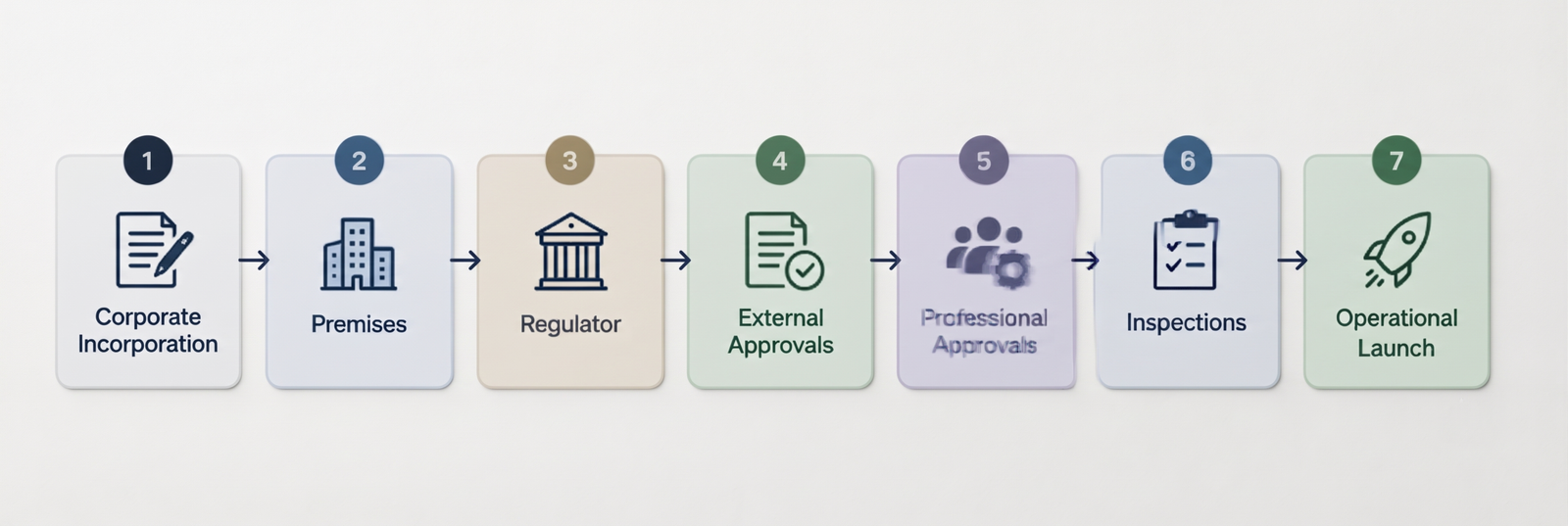
If these dependencies are discovered only after incorporation, an investor may find that the selected activity, premises or jurisdiction does not support the intended operation.
For regulated or complex establishments, the approval roadmap should therefore be designed before the company is formed.
11. What should the company look like three years from now?
One of the most useful questions in UAE market entry has nothing to do with the first year.
Evaluate:
- What could this company become?
- Will external investors enter?
- Will the founders raise venture capital?
- Will there be employee equity?
- Will the company acquire another business?
- Will the UAE entity become the regional headquarters?
- Will Saudi Arabia become the next market?
- Will a holding company become necessary?
- Could intellectual property be separated from operations?
- Could the shareholders sell the business?
No founder can predict every future development.
But foreseeable growth should influence the original structure.
This is particularly relevant as Dubai attracts more headquarters activity. Dubai retained its global No.1 position for headquarters greenfield FDI projects in 2025, while the Dubai International Chamber reported attracting 373 international companies during the year, including 64 multinational companies.
The UAE’s broader corporate framework is also becoming more flexible. The Ministry of Economy and Tourism reported that the number of companies in the UAE exceeded 1.4 million by the end of 2025, with approximately 250,000 new companies established during that year alone.
A structure that works for a founder on Day 1 should therefore also be tested against the business the founder hopes to build by Year 3.
12. What is the total market-entry cost – not just the licence price?
One of the easiest numbers to compare when entering Dubai is the licence fee.
It is also one of the easiest numbers to over emphasise.
The real market-entry budget can include:
- incorporation and registration
- annual licence
- establishment and immigration registrations
- office or workspace
- deposits
- visas
- medical tests and Emirates IDs
- health and other relevant insurances
- government approvals
- professional licensing
- document legalisation
- certified translations
- regulatory applications
- fit-out
- other necessary vendors and AMCs
- inspections
- banking preparation
- accounting and tax implementation
- any additional compliance
- technology and systems
- salary, gratuity
- other working capital
For a consulting business, some of these costs may be modest.
For a clinic, restaurant, warehouse or manufacturing business, they can be substantial.
The lowest incorporation price therefore does not necessarily produce the lowest total cost of entering the UAE.
More importantly, restructuring later can create another layer of cost.
Changing shareholders, adding a holding company, moving jurisdiction, replacing licences, changing premises, transferring contracts or reorganising bank relationships after a company is operational is usually more involved than analysing those questions before launch.
Why market-entry planning matters in 2026
The UAE continues to attract record levels of investment, trade and international business activity. But greater opportunity does not mean every structure is equally suitable.
For companies entering Dubai, the priority should be to choose a structure that fits the business model, customer base, regulatory requirements, ownership and future growth plans.
Start with the business model. Then choose the structure.
A UAE company can often be incorporated quickly. Restructuring it later – after contracts, employees, bank accounts, investors and licences are already in place – can be far more complicated.
The most important decisions are therefore often made before incorporation begins.
Planning a UAE Market Entry?
HelixVision helps international entrepreneurs and companies assess how their business intends to operate in the UAE before selecting a licence or jurisdiction.
Our market-entry approach can include assessment of the business model, customer geography, activity selection, jurisdiction, legal structure, ownership, regulatory requirements, premises, workforce planning, banking considerations and future expansion requirements.
The objective is not simply to establish a company.
It is to establish the right company for the business you intend to build.