

Intellectual Property in the UAE: What Businesses Should Protect Before Entering Dubai
A company preparing to enter Dubai will typically spend considerable time thinking about jurisdiction, licensing, visas, banking, premises and tax.
But one question deserves attention much earlier:
What exactly makes this business valuable – and who owns it?
For a consumer company, the answer may be its brand.
A technology business may find it in software, source code and proprietary know-how.
Manufacturers, on the other hand, may hold value in patents, product designs, processes and trademarks.
Consulting firms often hold value in methodologies, content, training materials and confidential commercial knowledge.
Yet many businesses treat intellectual property as something to address after incorporation.
That sequence can therefore create unnecessary risk.
Instead, a more strategic approach is to consider intellectual property alongside market entry and corporate structuring from the beginning.
Market entry is not only about establishing the company. It is also about protecting and structuring the assets that give the company value.
What Counts as Intellectual Property in the UAE?
Intellectual property is broader than trademarks.
For businesses, the principal categories can include:
Trademarks – names, logos and other signs used to distinguish goods or services.
Copyright – potentially relevant to qualifying software, written content, photography, video, designs and other original creative works.
Patents and utility models – relevant to qualifying inventions and technical innovation. The Ministry provides filing and management services for industrial-property rights including patents, utility models and industrial designs.
Industrial designs – potentially relevant to the visual characteristics of qualifying products.
Confidential know-how and undisclosed information – commercially valuable information may require a combination of applicable legal, contractual and operational protections.
For modern businesses, there may also be valuable digital assets that require more nuanced analysis: software, source code, datasets, domain names, algorithms, documentation and proprietary processes.
Not every asset receives the same protection.
The first step is therefore not simply “register the IP.”
It is:
Identify what the business actually owns.
Registering a Company Does Not Automatically Protect the Brand
In fact, this is one of the most important distinctions for international founders entering the UAE.
A company registration, trade name, domain name and trademark serve different functions.
Businesses should not treat a company license under a particular trade name as a substitute for a trademark strategy.
The UAE Ministry of Economy and Tourism administers the federal trademark registration system under Federal Decree-Law No. 36 of 2021 on Trademarks. Its current registration process includes examination, publication in the official trademark bulletin, a 30-day opposition period and final registration following completion of the applicable process.
This leads to a simple but important principle:
Registering the company does not automatically mean you have protected the brand.
Imagine an international business spending heavily on its Dubai launch: office fit-out, digital marketing, signage, recruitment, events and partnerships.
Discovering a brand conflict after that investment is considerably more complicated than investigating availability during the planning stage.
This applies equally to Mainland and Free Zone companies. A Free Zone license does not replace trademark registration, because the federal system handles that separately. Whichever jurisdiction a company chooses, it should plan brand protection alongside the licensing decision rather than assume the license covers it.
Trademark Strategy Should Begin Before Market Launch
A UAE trademark strategy can involve more than submitting an application.
Businesses should consider questions such as:
- Which names, logos or product brands are commercially important?
- Who should own the trademark?
- In which goods/services classes is protection relevant?
- Is the proposed mark available?
- Are different versions of the brand strategically important?
- Is Arabic branding or transliteration relevant?
- Are domains and digital identities controlled?
- Will distributors, franchisees or other partners use the mark?
- Is protection required only in the UAE or across several markets?
International companies should also consider how UAE protection fits within their wider portfolio.
The UAE joined WIPO’s Madrid System in 2021, with the Madrid Protocol taking effect for the UAE on 28 December 2021. The system provides a mechanism through which eligible trademark owners can seek protection across participating jurisdictions through an international registration framework. WIPO
However, that does not mean an international registration automatically produces identical rights everywhere. Each designated jurisdiction’s applicable framework still matters.
For patents, the UAE has also been a contracting state of the Patent Cooperation Treaty since March 1999. WIPO
Businesses should therefore assess the appropriate national or international filing strategy with qualified IP professionals.
Who Should Own the Intellectual Property?
This is where intellectual property becomes a corporate-structuring question.
Consider three simplified models.
Model A – The UAE operating company owns the IP
The company conducting the business also owns relevant trademarks, software or other intellectual property.
This can create structural simplicity in some circumstances, but it also places operating activities and IP ownership within the same entity.
Model B – The foreign parent owns the IP
An international company may already own its brand, software or technology before entering Dubai.
It then establishes a UAE subsidiary that uses the parent’s intellectual property under appropriate arrangements.
This may be logical when a multinational group wants centralized ownership of global IP.
Model C – A separate entity owns relevant IP
In some corporate groups, particular intellectual-property assets may sit in a separate holding or IP-owning entity, while operating companies receive appropriate rights to use those assets.
However, none of these models is universally “best.”
Rather, the appropriate structure can depend on where the IP originated, investor requirements, commercial risk, licensing arrangements, tax, transfer pricing, expansion strategy and potential future exits.
Businesses should therefore not create an IP holding company simply because it sounds sophisticated or because they assume it delivers a tax advantage.
Design corporate structure and IP structure together.
What Happens When the Parent Owns the IP?
Consider a European software company establishing a subsidiary in Dubai.
The European parent owns:
- the trademark;
- software platform;
- source code;
- product documentation; and
- other proprietary technology.
Meanwhile, the Dubai subsidiary will sell the product to regional customers.
A practical question immediately arises:
What rights does the UAE company have to use those assets?
Depending on the structure, appropriate intercompany arrangements may need to address matters such as territory, permitted use, exclusivity, duration, brand standards, intellectual-property improvements and commercial terms.
If royalties or other related-party charges apply, the tax analysis also matters.
The UAE Federal Tax Authority states that transfer-pricing rules require related parties to conduct their transactions on arm’s-length terms. The FTA also confirms that UAE transfer-pricing rules can apply to domestic as well as cross-border related-party transactions. FTA UAE
That means companies should not design IP licensing between related entities in isolation from corporate-tax and transfer-pricing considerations.
Overall, the commercial structure, legal documentation and tax treatment need to work together.
Technology, AI and Software Companies Need a Wider IP Conversation
For technology businesses, however, a trademark may be only one part of the intellectual-property picture.
Suppose an AI startup has developed a proprietary platform.
Who wrote the source code?
Did the founders create it before incorporation?
Did the company outsource some development?
Have overseas contractors contributed?
Does the code include open-source components?
Does the product depend on third-party APIs or foundation models?
Who controls the datasets?
What rights does the company have over training data?
What do third-party license terms permit?
Who owns product improvements created by employees in Dubai?
These questions therefore sit across intellectual property, contracts, data rights, privacy and technology licensing.
Simply registering the company’s name cannot solve them.
Federal Decree-Law No. 38 of 2021 governs the UAE’s copyright framework, and the Ministry currently provides a registration service for intellectual works. Ministry of Economy and Tourism
But businesses should not assume that every digital asset – particularly AI-generated material – automatically receives the same form of protection. AI output, training data, model rights and third-party platform terms can raise fact-specific and evolving legal questions.
Specialist legal advice becomes particularly important where the company’s valuation depends heavily on proprietary technology.
IP Ownership Should Be Documented, Not Assumed
Another common issue emerges when businesses hire people to create valuable assets.
A company may pay an employee, freelancer, software developer, designer or agency and assume:
“We paid for it, therefore we own everything.”
Businesses should check that assumption rather than rely on it.
Businesses should therefore review appropriate employment, development, contractor, confidentiality, assignment and licensing arrangements with qualified legal advisers.
This becomes especially important when external teams contribute to:
- software;
- websites;
- applications;
- branding;
- product designs;
- photography;
- videos;
- methodologies;
- technical documentation; or
- inventions.
The strategic principle is straightforward:
Document IP ownership; do not assume it.
International Brands, Franchises and Distributors
IP planning is equally important for established brands entering the UAE through partners.
Imagine an international consumer brand appointing a distributor before resolving who will control local trademark use, domains, digital channels and marketing assets.
Or a franchise system expanding into Dubai before establishing how the UAE operator can use the franchisor’s marks and proprietary materials.
The issue is not simply whether a contract exists.
Instead, the company should understand how brand ownership, permitted use and commercial relationships fit together.
This is especially important when the relationship later changes.
Companies should therefore consider IP strategy before granting significant market access to distributors, franchisees or other commercial partners and obtain specialist advice on the relevant contractual and regulatory framework.
IP Can Matter During Investment Due Diligence
A startup’s website may say:
“Our proprietary technology…”
An investor may ask:
“Show us who actually owns it.”
This can expose problems that stayed invisible during the early stages of the business.
The source code may still belong to a founder.
Likewise, a freelancer may never have signed an appropriate assignment.
The founder may have registered the trademark personally rather than in the corporate structure.
The operating company may also depend on software owned elsewhere without clearly documented rights.
Or the company’s core product may depend on third-party licenses whose terms need review.
If a company’s valuation depends substantially on technology or brand value, ambiguity around ownership can become commercially significant.
For that reason, founders planning future investment should organize IP ownership before due diligence begins.
IP Strategy and UAE Corporate Structuring Should Connect
Before incorporating a UAE company, analyze:
- Where is the existing IP?
- Who owns it today?
- What does the UAE entity actually need to use?
- Does the business plan to create new IP in Dubai?
- Will investors eventually invest in the UAE company?
- Could the UAE operation expand across the GCC?
- Might the group eventually need several operating subsidiaries?
- Is an eventual sale or investment round part of the strategy?
These questions lead to a more intelligent sequence:
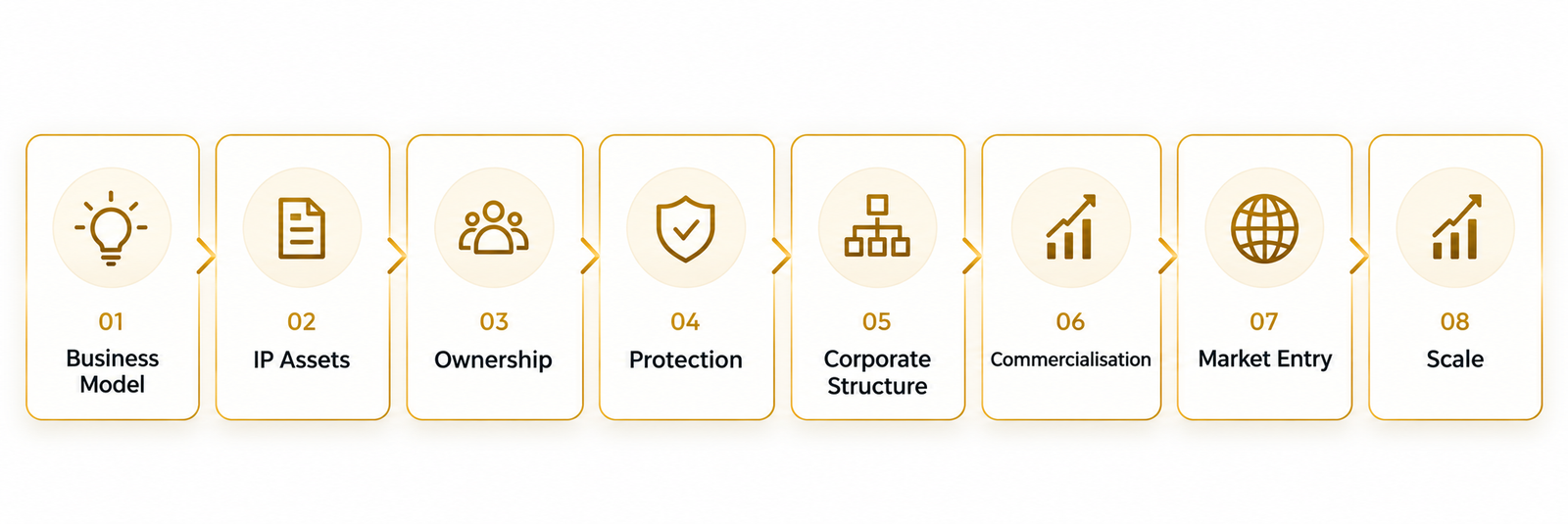
This is fundamentally different from registering a company first and organizing intellectual property later.
IP, Corporate Tax and Transfer Pricing
IP structures can also have tax consequences.
For example, where one group entity owns intellectual property and another pays for the right to use it, the group needs to consider related-party pricing.
The UAE Corporate Tax framework applies transfer-pricing principles to transactions between Related Parties and Connected Persons, and the FTA states that parties should determine such transactions on an arm’s-length basis. FTA UAE
This is why businesses should be cautious about structures marketed primarily around perceived tax savings.
Moving a trademark, software platform or patent between entities can have legal, valuation, accounting, tax and transfer-pricing consequences in multiple jurisdictions.
Drive IP ownership decisions commercially and assess them together with legal and tax advisers.
Protecting IP Beyond the UAE
Dubai is often not the final destination in a company’s expansion strategy.
A business may use the UAE as a platform for wider GCC, Middle East or international growth.
That makes territorial planning especially important.
Businesses should not simply assume that trademark, patent and other IP rights extend from one country into another. International mechanisms can make multi-jurisdictional protection more efficient in appropriate circumstances, but they do not remove the need for jurisdiction-specific analysis.
The UAE participates in both WIPO’s Madrid System for international trademark registrations and the Patent Cooperation Treaty framework for patent applications. WIPO
Companies planning regional expansion should therefore develop an IP roadmap alongside the commercial expansion roadmap.
Protection Does Not End With Registration
Registration is only one part of an IP strategy.
Owners also need to monitor their rights and, where necessary, enforce them through appropriate channels.
For businesses concerned about counterfeit physical goods entering Dubai, Dubai Customs operates a trademark-recording mechanism for customs protection. Its current service also requires a valid trademark registration certificate issued by the UAE Ministry of Economy and Tourism, among other applicable documentation. Dubai Customs
Dubai Customs explains that recorded trademarks support customs enforcement and the ability to file complaints regarding potentially infringing imports. Dubai Customs
The Ministry also maintains a process for copyright-infringement complaints, requiring documentation showing the alleged infringement and evidence of ownership. Ministry of Economy and Tourism
The appropriate enforcement route depends on the right, infringement and circumstances, and businesses may also need specialist IP counsel.
Seven IP Mistakes Businesses Should Avoid When Entering Dubai
- Assuming the trade name protects the brand. Consider company establishment and trademark protection separately.
- Launching before checking the brand. Significant marketing investment before trademark clearance can create avoidable commercial risk.
- Not knowing who owns the IP. A founder, parent company, contractor and operating company may each have different rights.
- Ignoring employee and contractor arrangements. Document valuable IP ownership properly.
- Giving commercial partners uncontrolled access to brand assets. Distribution and franchise expansion should incorporate an IP strategy.
- Building an IP holding structure purely for perceived tax benefits. Legal, tax, valuation and transfer-pricing implications require proper assessment.
- Waiting for an investor to discover the problem. Organize ownership and documentation before fundraising or due diligence.
UAE IP Market-Entry Checklist
Before launching in the UAE, analyze:
- Have we identified our core IP assets?
- Do we know who legally owns them?
- Have we assessed trademark availability?
- Have we considered appropriate UAE protection?
- Does the UAE entity have the rights it requires?
- Are intercompany IP arrangements properly documented?
- Have we assessed the relevant tax and transfer-pricing implications?
- Do we control important domains and digital brand assets?
- Is confidential information appropriately managed?
- Can the structure accommodate future investors?
- Can the IP strategy support future regional expansion?
If several of these questions remain unanswered, the company may be ready to incorporate – but its intellectual property strategy may not yet be ready for market entry.
The HelixVision Perspective
Intellectual property should not be an afterthought to UAE incorporation.
For businesses built around technology, brands, content, products or proprietary knowledge, it may represent a significant part of enterprise value.
At HelixVision, we believe these questions should form part of the market-entry conversation from the beginning – alongside jurisdiction, corporate structure, banking, operational requirements and future growth.
Where businesses need specialist legal, tax, valuation or IP advice, advisers should coordinate those disciplines around the same commercial strategy.
The objective is not simply to register a company in Dubai.
Instead, it is to enter the UAE with clarity over what the business owns, what needs protection, who should own it and how those assets will support future growth.
Planning to enter the UAE? Speak to HelixVision about your market-entry and corporate structuring questions, including how intellectual property fits into your plans. Contact our team to discuss jurisdiction, structure, and how to coordinate specialist legal, tax and IP advice around a single commercial strategy.
Related reading: Preserving Innovations: A Strategic Approach to Intellectual Property Management
FAQs
Does registering a company in Dubai protect its name as a trademark?
Company/trade-name registration and federal trademark registration are distinct processes. Businesses seeking trademark protection should therefore assess registration separately through the UAE’s trademark framework. Ministry of Economy and Tourism
How are trademarks registered in the UAE?
The Ministry of Economy and Tourism administers the federal registration service. Its current process includes application and examination, publication following acceptance, a 30-day objection period and, finally, registration after completion of the applicable requirements. Ministry of Economy and Tourism
Can a foreign company own IP used by a UAE subsidiary?
International corporate groups can have IP owned outside the UAE while a UAE entity has appropriate rights to use it. However, the exact ownership, licensing, tax and transfer-pricing arrangements require case-specific legal and tax analysis.
Should the UAE operating company own the IP?
Not necessarily. Operating-company ownership, parent-company ownership and separate IP/holding structures can each be appropriate in different circumstances. Rather, the decision should follow commercial, legal, tax, investor and expansion considerations.
Is software protected by UAE intellectual-property law?
Software can engage copyright and other legal and contractual rights depending on the asset and circumstances. In addition, the UAE’s copyright framework is Federal Decree-Law No. 38 of 2021, and the Ministry provides intellectual-works registration services. Ministry of Economy and Tourism
Can a UAE trademark be protected internationally?
The UAE participates in WIPO’s Madrid System. Eligible rights holders can use the international system to seek trademark protection in participating territories, subject to the applicable system and each designated jurisdiction’s treatment of the application. WIPO
Can IP be licensed between related companies?
Yes, IP may form part of intercompany arrangements, but businesses should assess the legal, commercial and tax consequences. UAE transfer-pricing rules require Related Party transactions to meet arm’s-length principles. FTA UAE